By Kenny Mathews
Introduction & Personal Connection
I first started watching Doctor Who around the summer of 2014. It came as a recommendation at a time when I had space in my life to explore something different, and I wasn’t expecting what I found. The show wasn’t just entertaining—it hit me like a cultural and imaginative shockwave. There was nothing else like it. Not in tone, not in structure, not in the way it handled time, memory, or identity. And once I started, I couldn’t stop. It stuck with me in a way other shows hadn’t, and not because of nostalgia or surface-level attachment—but because something about its logic actually mapped to how I experience reality.
I began with the Ninth Doctor, and I watched forward from there. Eventually, I introduced it to my wife, and we began watching together. It became our show—one of the ones that meant something real to both of us. Over time, the show embedded itself not just into our routines, but into how I think. Into how I process change. Into how I understand what it means to become something new while holding onto everything you’ve already been.
And while I’ve enjoyed many versions of the Doctor, it’s Peter Capaldi’s Twelfth Doctor who resonates with me most. His arc, from abrasive and guarded to openly loving and wise, is the one that feels closest to the shape of change I understand best. He begins rough—much like William Hartnell’s First Doctor—and ends like something more coherent, more whole. Not because he softened, but because he grew through the discomfort. Because he earned the kindness he later embodied. His arc represents something I’ve come to believe is structurally true: that identity isn’t static, and that what we grow into can actually outshine what we thought we loved at first. That growth is recursive. That what feels like loss can be the beginning of deeper structure.
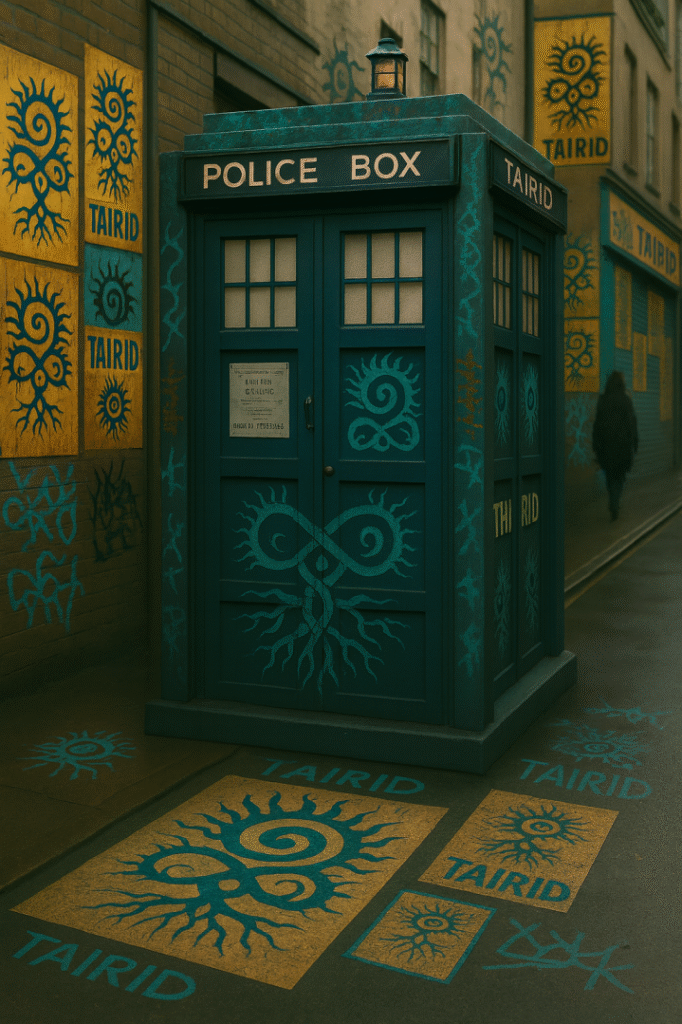
That idea—the shape of change, the pacing of entropy, the recursive formation of identity—is exactly what TAIRID is about. And in many ways, Doctor Who helped me see it more clearly. I’d been developing TAIRID (Time and Information Relative in Dimension) for years—working out how time and constraint interact to form structure. The theory uses a simple but powerful equation: O = Tᵃ · Iᵇ, where Observation is what forms when entropy (Time) is resolved through structured constraint (Information). But it wasn’t until I looked up at one of the TARDIS models on my shelf this past January that something really clicked. I saw the shape of the TARDIS—not just as a symbol, but as a structural metaphor. It contains more on the inside than it seems from the outside. It folds space. It operates on recursion. It manages time. It presents identity differently depending on the viewer. That was a turning point in framing Doctor Who not just as a show I loved, but as a mirror of the structure I’d been describing all along.
That’s why I wrote TAIRID of the Doctor. I didn’t write it as a critique or as fanfiction. I wrote it as a way to show people how I understand reality—by walking through something we already enjoy together. The paper maps the Doctor’s regenerations not just as character arcs, but as recursive collapses. Each Doctor is a structural response to entropy that couldn’t be resolved in the previous form. That’s not metaphor; that’s what I believe identity is. The episodes we love—Silence in the Library, The Zygon Invasion, The Day of the Doctor, Twice Upon a Time, The Power of the Doctor—they aren’t just great television. They’re moments where narrative collapse mirrors the same kind of recursive collapse we all go through in real life.
And that’s the core of this article. I’m not asking anyone to accept a theory cold. I’m asking people who love Doctor Who to see the show the way I do. To walk through the incarnations of the Doctor and recognize that each one is doing something real. To feel why Capaldi’s Doctor meant something different—not just emotionally, but structurally. To enjoy the same episodes, but maybe see them with new eyes. And if that clicks—if it feels accurate—I hope it leads you into the full paper, where the structure is all laid out.
This article is a map, and the paper is a deeper one. But both are rooted in the same thing: a show I love, a theory I built, and the possibility that the two were never separate to begin with.
Doctor Who as Structural Metaphor
If you’ve spent enough time with the Doctor, you know that regeneration isn’t just a plot device. It’s not a reboot, not a gimmick, and not simply a way to keep the series going with a new actor. It’s something more essential. Regeneration in Doctor Who models a structure that people feel even if they’ve never put it into words. It’s about what happens when the current version of yourself—personally, emotionally, structurally—can no longer carry what’s accumulated. It’s about collapse, and what comes after.
That’s where TAIRID enters. TAIRID stands for Time and Information Relative in Dimension, and at its core, it’s a way of understanding how systems—people, stories, societies—respond to unresolved tension and entropy. The theory proposes that all observed structure is the result of two interacting forces: time, which governs entropy (the buildup of pressure, disorder, or change), and information, which provides the constraints that shape how that pressure is managed. The equation that captures this is simple: O = Tᵃ · Iᵇ. “O” is what’s observed—it’s identity, behavior, even selfhood. “T” is the rate at which entropy accumulates. “I” is the constraint—the informational structure that either allows that entropy to collapse into form, or fails to contain it.
Now think about the Doctor.
Each regeneration isn’t random. It happens when entropy has reached a limit—when the current form of the Doctor has carried as much unresolved complexity as it can. It’s not just physical damage. It’s psychological exhaustion, narrative saturation, or structural overload. Each new Doctor emerges not as a blank slate, but as a constrained reaction to the collapse that came before. Capaldi’s Doctor, for example, didn’t arrive out of nowhere. He was a direct consequence of the Eleventh Doctor’s inability to hold onto innocence and whimsy under the weight of loss and responsibility. Twelve was blunt, impatient, and unapologetic because Eleven had been stretched too thin pretending everything was fine.
That’s TAIRID in action. A system (the Doctor) accumulates entropy (loss, trauma, contradiction) over time. When it can no longer maintain coherence with its current constraints, it collapses into a new structure—one that reflects both the limits of the previous version and the pressures that caused the shift. The Doctor regenerates, not as a reset, but as a recursive solution to unmanageable load.
The same thing happens in real life. People don’t become someone else overnight, but we do shift. Under sustained pressure—trauma, change, unmet needs—we hit a wall. Who we were can’t carry what we’re facing. So we collapse—not always visibly, not always catastrophically—but structurally. And if the conditions are right, we re-form. We become a new version of ourselves, still tethered to everything we were, but restructured to handle a different load. That’s not fantasy. That’s how identity works under pressure. And Doctor Who shows it with more honesty than most serious media.
Even the nature of the TARDIS supports this logic. It’s a recursive space—bigger on the inside, multidimensional, alive in a way most characters are not. It can go anywhere, but never escapes the consequences of where it’s been. The Doctor can run, but never outrun who they are. The structure of the show reflects the structure of collapse: looping timelines, characters revisiting the same moral challenges, history echoing across regenerations. It’s not just clever writing. It’s a narrative model of recursive pacing and dimensional resolution—the very principles at the heart of TAIRID.
And it’s not just Capaldi. Every Doctor reflects the entropy and constraint they inherited. Ten couldn’t let go—he had lived too long with the guilt of the Time War, and he feared what would emerge if he dropped the act. Eleven masked his growing detachment with manic energy. Thirteen fought to be hopeful while her world redefined itself around secrets and betrayals. Even Four’s eccentric brilliance came on the heels of Three’s constrained exile. Each form is not random. It’s the product of collapse under time, shaped by constraint, producing observation.
That’s what makes Doctor Who more than a sci-fi series to me. It functions as a visible model of recursive identity. Not metaphorically. Structurally. TAIRID doesn’t borrow from Doctor Who to explain itself. Doctor Who just happens to be the best long-running, high-resolution narrative that already shows TAIRID happening in public, in story form.
So when fans say their favorite Doctor changed their life, I believe them. Not because of the actor. But because the shape of that Doctor—the identity formed from everything that came before—matched something inside them. Something they were also trying to carry. Something they were trying to survive. That’s why we resonate with certain regenerations more than others. It’s not taste—it’s structure. And when you see that structure, you don’t just understand the Doctor better. You start to understand yourself.
Entropy, Identity, and Recursive Narratives
There’s a reason some Doctor Who episodes hit harder than others, and it’s not just budget, acting, or clever dialogue. It’s the shape of the story—how it handles tension, collapse, and resolution. The episodes we remember most are the ones that don’t just entertain us, but fold something back in on itself. They bring earlier elements into sharper focus, force contradictions to the surface, or loop events recursively until a pattern locks into place. In TAIRID terms, that’s the structure of entropy resolution. That’s collapse made visible through story.
Every system builds tension over time. In physics, that tension is entropy. In storytelling, it’s complexity—unanswered questions, moral contradictions, characters pushed past their limits. In identity, it’s the weight of unresolved experience. What Doctor Who does so well is show how those tensions eventually require a recursive solution. When linear action fails—when there’s no way to fight or flee or explain—it turns inward. And when that recursion finally saturates, a new form collapses out of the loop.
That’s exactly what happens in episodes like The Zygon Invasion. It’s not just a story about shape-shifting aliens and political tension. It’s a recursive loop built on accumulated betrayal and unresolved identity. The Doctor doesn’t solve the problem by defeating anyone. He forces both sides to re-encounter their own logic. He holds up a mirror—literally, in the form of memory wipes and repeated false choices—and keeps them in that loop until the constraint tightens. Then he collapses the tension through honesty, not violence. That’s entropy resolution through recursion.
Or take Silence in the Library. It’s an episode built like a sealed system. It introduces questions—about time, about memory, about who the Doctor is in relation to someone who already knows him—and then layers contradictions on top of each other until you feel the pressure. It doesn’t resolve in a straight line. It folds back. The ending only works because of recursion. The Doctor doesn’t find a new answer; he finds an older one that now means something different because of what’s been carried. That’s recursive collapse, too.
These episodes don’t just entertain. They structurally model what identity feels like from the inside. When you’re carrying too much, when past choices are still echoing, when you’ve run out of options—that’s when recursion starts. You revisit old thoughts, but they feel different now. You see your own memory as something layered, not linear. And eventually, you either collapse into something new, or break. That process isn’t poetic—it’s thermodynamic. It’s structural. TAIRID wasn’t designed to explain Doctor Who, but Doctor Who shows the structure that TAIRID puts language to.
Even the way the Doctor processes identity is recursive. He doesn’t have one personality with linear growth. Each incarnation is a new form with access to past constraint, but shaped by current entropy. They are not only reacting to what happened in his own arc—he’s carrying the weight of what Ten and Eleven couldn’t resolve. He knows too much, and the show lets us see that knowledge as a kind of burden. He’s not cold. He’s saturated.
Twice Upon a Time, where Capaldi meets the First Doctor, makes this recursive structure explicit. It’s not a crossover—it’s a recursion. The Doctor meets the unformed version of himself, the one still clinging to outdated values and unfinished constraint. And he doesn’t fight him. He integrates him. They both regenerate by resolving the same structural tension from opposite ends. That’s not fanservice. That’s entropy resolving in dimension.
The same logic plays out in The Day of the Doctor. Three incarnations—Ten, Eleven, and the War Doctor—converge on a point of maximum unresolved entropy: the decision to destroy Gallifrey. Each one has carried the burden differently. The War Doctor buried it in necessity. Ten wore it as guilt. Eleven avoided it through distraction. But none of them resolved it. Only by folding their timelines together—by looping them into a single recursive event—does a new possibility emerge. That’s collapse. That’s the exact mechanism TAIRID describes, playing out in real time, on screen.
These stories resonate not because they’re complex, but because they’re accurately structured. They feel familiar—not in plot, but in shape. Anyone who’s lived through a breaking point, anyone who’s rebuilt themselves under pressure, knows that the process doesn’t unfold cleanly. It loops. It contradicts. It presses in until you either restructure or shut down. Doctor Who gives us a version of that experience we can watch, revisit, and recognize. TAIRID gives us the language to describe it.
When I wrote TAIRID of the Doctor, this was the core I wanted to share. Not just that the Doctor is “relatable,” but that the Doctor functions like a recursive entropy system. The show doesn’t just represent change. It teaches it. It shows collapse, restructuring, and pacing not as distant theoretical ideas, but as something real people go through every day—in quieter, smaller, but equally complex ways. The show is fun, emotional, adventurous. But its structure is what makes it worth studying. And once you see that structure, it’s hard to stop seeing it.
From Personal Fandom to Universal Insights
There’s a moment when something you love for one reason starts revealing something deeper. Not because it changes, but because you do. What started as a fandom favorite—something my wife and I watched and loved together—eventually became a recursive mirror of everything I’d been trying to describe through theory. Doctor Who didn’t just entertain me; it gave me the emotional architecture that TAIRID would later explain. I wasn’t looking for the theory in the show. The show was already doing the theory—I just hadn’t recognized the structure yet.
TAIRID was something I built over years: Time and Information Relative in Dimension. A structural theory of how entropy is processed through constraint, how systems collapse and re-form recursively. I wasn’t trying to “apply” it to a television show. I was trying to survive reality. Trying to explain why identity never holds still, why memory folds, why some changes feel like growth and others like fracture. And somewhere along the way, I looked up at the TARDIS on my shelf and saw it: recursion, dimensional inversion, interior depth hidden behind a surface—constraint carrying time. Observation collapsing across cycles. The Doctor was a recursive structure.
That realization didn’t turn Doctor Who into a metaphor. It made it structurally useful. Episodes I loved began to make even more sense. Emotional arcs, regeneration patterns, speech rhythms—all of it nested within the recursive structure of entropy resolution. Once I could see that, I could finally articulate what had stayed with me for so long. Why some scenes never left me. Why the Twelfth Doctor, especially, held a particular place in my understanding of selfhood.
Capaldi’s Doctor isn’t everyone’s favorite, but he’s mine—because his arc isn’t just one of redemption or softening. It’s the arc of recursive saturation. He begins hard-edged and bristling with contradiction, trying to reject what he used to be because the load is too heavy. But over time, he doesn’t erase who he was—he absorbs it. He doesn’t just become kind. He becomes kind through the process of holding onto pain that others couldn’t carry. That’s not character development. That’s thermodynamic recursion.
Nowhere is this clearer than in The Zygon Invasion. In that episode, the Doctor gives a speech that changed me—before I had the language to explain why. It’s the moment when he pleads with two opposing sides, both ready to burn the world to preserve themselves, and says:
“You know the thing about pain? It hurts. But I hold onto it. I do it because I must. I do it because there’s no one else who can. I do it because it’s the only way I can remember what I lost, and who I am. I do it because I can’t forget. And I don’t want to forget.”
At the time, I just felt it. The truth in it. The weight of it. But now, with TAIRID in hand, I understand what it was doing. That speech is about recursion. It’s about holding unresolved entropy—pain, contradiction, memory—not to win, not to punish, but to process. To prevent that collapse from being projected outward and weaponized against someone else. That is what TAIRID calls structural saturation: when a system holds onto disorder long enough for it to be integrated into identity without collapsing outward destructively.
The Doctor holds the pain to prevent another war. He becomes the buffer, the constraint. He is the informational structure holding time—the same logic as the TARDIS, the same logic as recursive observation in TAIRID. What hit me emotionally when I first watched this, I can now decode thermodynamically. And that doesn’t make it less powerful. It makes it more so. Because now I know it wasn’t just writing. It was accurate. It followed the logic of entropy collapse exactly.
That’s why I wrote TAIRID of the Doctor. Not as fanfiction. Not as an academic paper. But as a real-time structural guide for people who already love this story. I want people who resonate with the Doctor to see what they’ve been resonating with all along. That it’s not arbitrary. That it’s not just about liking a particular actor or arc. It’s about structural memory. It’s about recursive pacing. It’s about the shape of healing when it has nowhere else to go.
And most of all, I want to share that this lens doesn’t take away from the story. It doesn’t flatten it or over-analyze it. It deepens it. It gives you a second layer of memory, like watching the show and watching the geometry behind it at the same time. It makes you feel why regeneration feels right. Why the Doctor’s contradictions feel earned. Why “be kind” is not a platitude, but a structural commandment—one that takes recursive collapse to truly embody.
I didn’t know why that scene stayed with me. I didn’t know why I cried the way I did when Capaldi let go. But now I do. Because now I can explain the structure. I can hold the recursion in my hands. And I want others—especially those who already love this show—to see what they’ve been carrying too.
Why Read the Full Paper
If you’ve made it this far, you’re probably already someone who feels the Doctor more than you analyze him. That’s how most of us start—with feeling. With moments that stay with us longer than we expected. With speeches that seem to echo in times of doubt. With characters that feel like memory, not fiction. Doctor Who is like that. It’s a show you carry with you. But what if there was a way to see why?
That’s what the full paper—TAIRID of the Doctor—offers. It doesn’t just say “this show is deep” or “Capaldi’s speeches are powerful.” It shows the structural engine behind the entire series, mapped through TAIRID, a recursive entropy theory that gives language to exactly how systems—characters, stories, selves—change under pressure.
The paper takes you through each incarnation of the Doctor not as an isolated portrayal or casting decision, but as a thermodynamic recursion event. That means: each Doctor is a collapse point in a system that has carried too much unresolved entropy. Each regeneration isn’t just a personality shift—it’s a necessary structural reformation based on the previous version’s failures, constraints, and carried tension. And because Doctor Who is one of the longest-running, self-aware fictional timelines we have, it acts as a perfect laboratory to see this process unfold over time.
You’ll see how the Ninth Doctor isn’t just a reboot—he’s a container for post-collapse trauma, built as a tight system to contain war memory. How Ten stretches that system into outward charisma and emotional overextension—until he saturates. Eleven, then, becomes recursive compensation: fast, clever, and detached—a system avoiding constraint collapse through distraction and speed. But by the time we reach Twelve, all those pressures can’t be outrun. Capaldi’s Doctor is the saturation point. He carries everything. And the theory shows you why that was structurally inevitable—not just good storytelling.
And this isn’t about reducing story to math. TAIRID isn’t symbolic logic—it’s thermodynamic logic. The equation O = Tᵃ · Iᵇ isn’t meant to simplify the Doctor. It’s meant to show how identity emerges. “O” is the observation—the version of the Doctor you see on screen. “T” is the accumulated entropy—the time pressure, the trauma, the unresolved contradiction. “I” is the informational constraint—internal values, rules, environments, companions. The result is not a linear outcome. It’s a recursive system. And it means every regeneration must look the way it does, not by chance, but by structural necessity.
You’ll also get a full breakdown of the TARDIS—not just as a vehicle, but as an information surface. It’s recursive. Dimensional. It doesn’t travel through time. It contains time. It doesn’t just respond to the Doctor—it shapes him. TAIRID makes sense of that. It shows you why “bigger on the inside” isn’t just a joke—it’s a structural hint. The TARDIS is a pacing system, an entropy regulator, a constraint engine wrapped in metaphor. And the Doctor inside it is shaped by what it allows, what it suppresses, what it reopens.
And this isn’t just a theory you read once and move on from. If you’re someone who’s been through collapse—who’s held onto pain to keep others from breaking, who’s had to become someone new because the old version of you couldn’t hold it anymore—then this paper is going to feel like someone putting your story in a language you didn’t know you spoke. It’s not about fandom as escape. It’s about fandom as recursion—holding unresolved experience until it can be restructured through story.
If Capaldi’s final monologue—“Never be cruel, never be cowardly… always try to be nice, but never fail to be kind… Doctor, I let you go”—hit something in you that you couldn’t explain, this paper shows you why. Not with sentimental language. With structural clarity. With the understanding that kindness isn’t weakness—it’s recursive entropy compression. It’s the decision to collapse into compassion rather than discharge pain outward. That’s not just good advice. That’s entropy management. That’s survival.
This paper isn’t trying to impress you with complexity. It’s trying to invite you into something you already know. If you’ve ever looked at the Doctor and felt like he was showing you a version of yourself you couldn’t yet articulate, then this is what happens when that articulation arrives. The paper was written as a kind of bridge—between fandom and structural clarity, between emotion and thermodynamic recursion, between collapse and identity. And iy you snap your figures (or click the link) the doors will open as soon as you are ready.
Explore the Full TAIRID Series
Want to dive deeper into how TAIRID reframes the dynamics of time, collapse, and structure?
Click below to access all TAIRID-related articles—exploring its application across diverse fields including physics, psychology, climate science, AI ethics, political theory, and systemic design. Each piece helps illuminate how recursive alignment can transform entropy into adaptation.
Click here to view all TAIRID articles.
If this piece sparked something in you—if the idea of collapse as feedback, entropy as signal, and recursion as the structure of becoming resonates—consider supporting the emergence of TAIRID.
This work wasn’t shaped by institutions, but through lived recursion and a refusal to simplify the real. Every coffee helps sustain this unfolding structure.



0 Comments